Plinko is one of those games that hooks you instantly. You drop a ball, watch it bounce its way down the board, and hope it lands in a spicy multiplier on the edge.

Plinko Games at Sweepstakes Casinos (How They Work & How to Play Smart)
Inspired by the iconic pricing game from The Price Is Right, online Plinko at sweepstakes casinos is simple arcade-inspired fun: just pick your lines, choose a risk level, and let the math do the rest.
Get ready to learn how Plinko betting sweeps works, the math behind the game, and strategies you can use right now to land juicy 1,000x multipliers!
We research sweepstakes casinos with a focus on the details that matter most to players, including bonuses, usability, verification, redemptions, and overall experience. Our content is written to be clear, independent, and regularly reviewed as sites and offers change.
How Plinko Works in the Sweepstakes Format
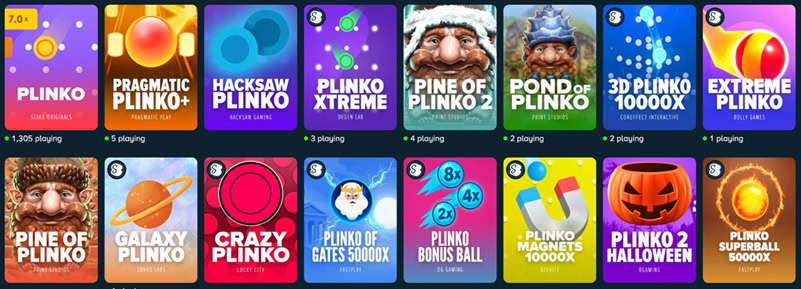
Dropping your first Plinko ball at sweepstakes casinos is so much fun. One second, it’s bouncing randomly, and the next, it lands in a huge multiplier bucket. To guide your Plinko balls like a pro, follow these steps:
Getting Gold Coins and Sweeps Coins
Before you drop a ball, you need virtual currencies. Sweepstakes casinos give you Gold Coins (GC) and Sweeps Coins (SC), usually through sign up bonuses, daily logins, mail-in promotions, or giveaways.
Gold Coins are for practice, as they allow you to play without risking redeemable currency. Sweeps Coins are the valuable part – each SC you spend can be redeemed for $1 after you meet playthrough requirements.
Choosing Game Mode: GC vs SC
Once you have coins, you need to decide on your mode. Gold Coin mode is for fun, while Sweeps Coin mode is where you can win real cash prizes.
After picking your currency, choose your Plinko game. Key factors to look out for before picking a game are RTP, max win, minimum and maximum stake, bonus rounds, and theme. We recommend starting with a bare-bones classic Plinko release with a high RTP, like Stake’s version.
Selecting Stake, Number of Balls, and Risk Level
Now that you’ve fired up sweepstakes Plinko game, you are almost ready to navigate the pegboard, but first you need to choose your stake per ball, number of balls per round, and risk level.
- Stake per ball determines the number of Sweeps Coins you’re risking per drop and how much each multiplier is worth. Your prize is calculated by stake times multiplier, so a higher stake can turn a 100x bucket into a huge payout, but it also depletes your coins faster. Lower stakes let you play more balls and learn the game mechanics without burning through your balance.
- Number of balls per round affects variance and risk distribution. Dropping multiple balls spreads your chances across several multipliers, often producing a stream of smaller wins. Single-ball drops are high variance, as they could hit a massive multiplier or result in nothing.
- Risk level changes the payout distribution of the multiplier buckets. Some games also allow you to adjust the number of pegs, which influences the ball’s path and the range of multipliers it can reach.
Dropping the Balls and Watching Them Bounce
Now comes the best part: actually dropping the balls. You click the play button, and a shiny ball starts its journey from the top, wobbling slightly as it begins to descend. It rattles off the first row of pegs, ricochets unpredictably, and then bounces again, spinning and careening left and right with every obstacle it hits.
As the ball moves through the maze of pegs, it teases you, hovering over mega multipliers before finally settling into a bucket at the bottom. The multiplier it lands in instantly calculates your prize.
Once one ball finishes, you can click play again to drop another. Each ball is independent, so even if the previous drops were unlucky, the next one could hit the top multiplier and turn a small stake into a massive win, just like in Mines, where you’re always one click away from glory.
Multiplier Ladders, Volatility & Payout Potential
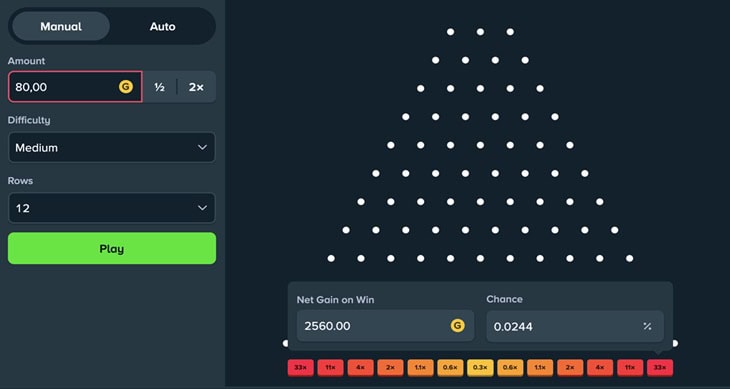
Plinko is a probability ladder disguised as a simple arcade game. Every board is built around a fixed multiplier distribution, with volatility controlled by line count and risk level. The max payout might be 1,000x, but the way multipliers are spaced and how rarely the top end is hit is what determines your expected return.
To play sweepstakes Plinko game properly, you need to understand where multipliers sit, how risk reshapes the board, and how RNG locks in results before the ball even drops.
Plinko Board & Multiplier Distribution
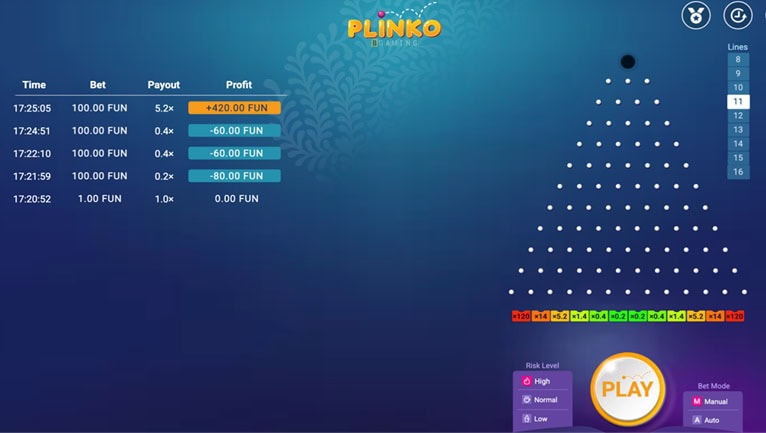
Plinko boards are structured around probability curves. The middle of the board at the bottom contains the highest-probability landing zones, which is why this area is packed with low multipliers. As you move toward the edges, the chance of the ball landing there drops sharply.
A typical layout might look like this:
- Multiple 0.2x-2x buckets clustered in the center
- Fewer mid-range multipliers spread slightly outward
- Only two extreme multipliers (such as 1,000x) sitting right on the edges
For example, you may see just two 1,000x buckets but seven buckets at 2x or lower. The more extreme the multiplier, the fewer buckets exist and the lower the probability of landing there.
Increasing or decreasing the number of lines changes this distribution. More lines create more buckets and finer probability splits, while fewer lines compress the board, reducing extremes but increasing repeatability.
Volatility & Risk Levels (Low, Medium & High)
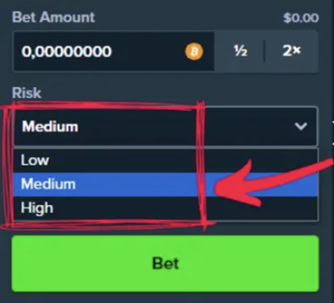
Risk level directly controls how wide the multiplier ladder stretches and how punishing misses can be.
Low Risk
Low-risk boards limit volatility by keeping both the ceiling and floor relatively tight.
- Top multiplier is usually capped around 5x-6x
- Lowest multipliers tend to sit around 0.5x
- Very few, if any, sub-1x outcomes
This setup produces consistent returns with minimal swings, but you sacrifice the chance of massive wins.
Medium Risk
Medium risk is where volatility becomes noticeable and where many players get caught out.
- Top multipliers are often 10x-15x
- Multiple sub-1x buckets (0.5x, 0.7x, etc.) appear across the board
- The center is still safer, but losses are more frequent than low risk
Medium risk raises the top-end multiplier and widens the entire ladder. You gain access to stronger payouts, but you also accept more frequent partial losses.
High Risk
High-risk boards are built for extreme variance.
- Top multiplier is typically 1,000x
- Lowest buckets can drop as low as 0.2x
- Large clusters of low multipliers dominate the center
While the 1,000x bucket exists, it’s balanced by a heavy concentration of low outcomes, so long dry streaks are expected.
Payout Potential vs Realistic Outcomes
The top multiplier in Plinko sweeps casino is usually 1,000x, but the maximum payout tells you almost nothing without context. What matters is how often that multiplier is mathematically reachable.
In BGaming’s Plinko, for example, the 1,000x multiplier has a hit probability of just 0.000015%. That means it’s designed to land once in tens of millions of drops. By comparison, center-board multipliers like 1x or 2x are hit constantly because they sit on the highest-probability paths.
How RNG Determines Each Drop
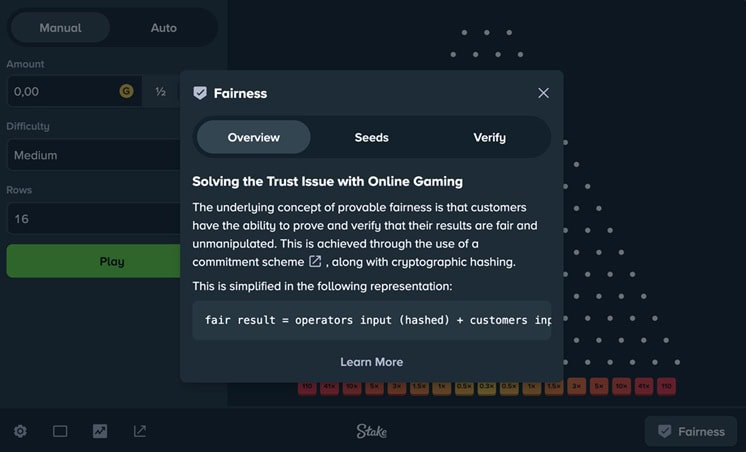
Despite the visual bouncing, Plinko outcomes are fully determined by RNG. The moment you press play, the result is locked in. The ball’s path, peg hits, and final landing position are animations mapped to a pre-selected multiplier. RNG ensures that:
- Lower multipliers are selected far more frequently
- Higher multipliers are exponentially rarer
- Risk level and line count only adjust probability tables, not randomness itself
Practical Plinko Tips for Sweepstakes Players
Plinko looks chill until it empties your balance in a blink of an eye! If you want more than vibes and crossed fingers, these tips will help you play sweepstakes Plinko game like an MIT math professor!
Common Misconceptions & Mistakes in Plinko
Plinko looks simple. All you need to do is drop a ball, land in a multiplier bucket, and celebrate. That simplicity is exactly why beginners fall into the same traps over and over. We’ve seen it ourselves and made a few of these mistakes early on. Let’s help you avoid succumbing to common Plinko pitfalls!
- Playing intoxicated because streamers do it – Fun to watch, but terrible to copy! Alcohol clouds judgment and leads to reckless drops.
- Chasing losses by increasing stake or risk – Plinko doesn’t owe you a win. Doubling down after losses just speeds up depletion.
- Ignoring responsible gaming tools – Limits and timers help you survive swings and live to fight another day.
- Focusing only on big multipliers – Obsessing over the top bucket can blind you to consistent wins that keep your balance healthy.
- Thinking patterns or rituals affect outcomes – Tapping a spot or dropping at certain angles won’t change the RNG.
- Overplaying after a big win – Hitting a huge multiplier is exciting, but putting the blinkers on and focusing on another immediately can erase your gains fast.
- Playing too many balls at once without tracking – It’s easy to lose track of coins or results if you just spam drops. This can lead to overspending.
- Switching risk levels constantly – Flipping between low and high risk mid-session confuses strategy and can backfire on your bankroll.
Now these common Plinko mistakes didn’t come out of thin air. They are the result of beginners misunderstanding the game and believing in nonsensical myths. Check them out below.
Big multipliers are due after lots of small ones
This is classic gambler’s fallacy. Each Plinko drop is completely independent, and past results have zero impact on future outcomes. Just because you’ve been hitting small multipliers doesn’t mean a 1,000x is coming next.
Sweepstakes casinos can control the multiplier bucket
Some beginners worry the platform manipulates outcomes. Reputable sweepstakes casinos don’t touch the results. Games are powered by audited RNGs or provably fair algorithms, so every drop is determined by math, not human hands.
Drop position affects the result
It might feel like dropping on the left or right changes your luck, but that’s an illusion. The result is generated at the moment you click drop, so your starting point doesn’t influence the multiplier you hit.
There’s a pattern or hot spot on the board
Some beginners watch previous drops and try to mimic where the ball landed before. Plinko boards are fully random, and no peg is luckier than another.
You can predict outcomes with timing or clicking speed
Unlike some arcade games, Plinko’s results are calculated instantly via RNG. Clicking faster or slower doesn’t influence which bucket the ball lands in.
High-risk always means better chances of hitting big multipliers
Choosing high-risk boards only changes payout structure, not probability mechanics. The game doesn’t make the top bucket more likely, it just increases variance.
Is Plinko the Right Sweepstakes Game for You?
Plinko is hands-down one of the most satisfying sweepstakes games to play. You click drop, watch the ball bounce off pegs, ricochet unpredictably, and finally land in a multiplier bucket up to 1,000x!
With an RTP of up to 99% and high max wins, it rivals online slots for volatility and payout potential, but you’re actually interacting with the game instead of just spinning. The game also comes in a ton of variants, from soccer fields to Greek mythology, and many games are provably fair, so you can forget about rigged rounds.
Compared to crash games, you don’t have to panic about hitting a cashout button, as the outcome is determined once the ball drops. It’s like a visual version of a multiplier curve, but you get to watch the balls dodge pegs, bump off each other, and land in the big buckets. So, if you enjoy slots’ volatility but want something more interactive and fun to watch, Plinko multiplier game is a perfect fit.
FAQs
Does where I drop the Plinko ball matter?
In Plinko sweeps casino, the drop position has no impact on the final outcome. The ball's path is determined by a random number generator (RNG). At each peg bounce, the direction the ball moves is mathematically random and unpredictable.
What risk level should beginners use?
For consistent returns and longer playtime, low risk with its frequent payouts is a safe pick. However, in our opinion, medium risk offers the best of both worlds with bigger than average wins but still a decent hit rate.
Are Plinko games fair at sweepstakes casinos?
Sweepstakes Plinko games are fair and are powered by audited RNGs. Each drop is completely random and not influenced by previous results. These games are operated by licensed providers or use provably fair algos, and outcomes can be independently verified.
Can I win big from small stakes in Plinko?
You can win big from small stakes in Plinko. Many Plinko games feature high-value buckets with multipliers of up to 1,000x, so even the smallest drop can turn into a massive win. You could turn your 1 SC daily login bonus into a 1,000 SC prize in seconds!
What are the best Plinko games at sweepstakes casinos?
The best Plinko games at sweepstakes casinos include Pine of Plinko 2, which invites you into a dwarves’ hideout to drop a Golden Ball for a shot at a 10,000x prize. Other top games are Plinko by Stake, offering provably fair gameplay with a 99% RTP, and Olympus Plinko, where Zeus blesses your drops and a progressive jackpot is up for grabs.
Can I play Plinko for free at sweepstakes casinos?
All Plinko games at sweepstakes casinos are free to play. You receive Gold Coins and Sweeps Coins through sign up bonuses, daily logins, giveaways, and mail-in offers. Sweeps Coins are used to play Plinko and, once played through, can be redeemed at $1 per SC.
What RTP does Plinko have?
Plinko has one of the highest RTPs among sweepstakes casino games, often reaching up to 99%. This means, on average, Plinko returns about 99 SC for every 100 SC wagered over the long term.

Author: Oliver Dickinson
Updated:
Oliver Dickinson is the head of strategy and serves as Lead Editor for Freaky Gaming. He has a lot of experience with sweepstakes casino style gaming and website publishing being part of many sweepstakes projects over the years. Oliver oversees editorial direction, review standards, and compliance, ensuring all content meets high standards of accuracy and transparency so that our users trust that our content is reliable.
Oliver Dickinson is the head of strategy and Lead Editor of Freaky Gaming, where he oversees content quality, and review standards across the site. With extensive experience in sweepstakes casino-style gaming and digital publishing, Oliver leads the development of Freaky Gaming’s review methodology and ensures every page is created with accuracy, transparency, and player value in mind.
Over the years, Oliver has worked across multiple sweepstakes gaming projects, giving him a strong understanding of how platforms operate, how offers are presented, and what players actually need to know before signing up. His work focuses on turning complex information into clear, practical guidance — whether that’s reviewing casino features, explaining bonus terms, or helping readers understand the differences between platforms.
As Lead Editor, Oliver is responsible for maintaining editorial consistency and ensuring content aligns with Freaky Gaming’s standards for factual accuracy, responsible messaging, and legal/compliance awareness for a U.S. audience. He works closely with reviewers, writers, and editors to make sure content is regularly checked, updated, and easy to trust.
Oliver’s editorial approach is rooted in a simple principle: readers should be able to make informed decisions based on honest, well-structured information not hype. That philosophy continues to shape Freaky Gaming’s voice and content standards across reviews, guides, and educational pages.